

Corporate training has a dirty secret: most of it doesn’t stick. Employees sit through a course, complete the assessment, and return to their desks — where 70% of what they just learned evaporates within a week. In 2026, forward-thinking organisations are finally addressing this with a deceptively simple idea: stop pulling people out of their work to learn, and start bringing the learning to the work.
This is the principle behind one of the most significant shifts in L&D this year — and it’s changing what organisations expect from their learning platforms.
What “Learning in the Flow of Work” Actually Means
The concept, popularised by industry analyst Josh Bersin, is straightforward: learning is most effective when it happens at the moment of need, in the context of actual work. Instead of scheduling a training day three months before a skill is needed, employees access bite-sized, relevant content right inside the tools they already use — their CRM, project management dashboard, or communication platform.
Think of it as the difference between studying a map before a road trip and having GPS navigation as you drive. The information is the same; the timing and context make all the difference.
In 2026, AI is making this genuinely scalable. Intelligent LMS platforms can now detect where an employee is in their workflow, anticipate what knowledge they might need, and surface the right resource at precisely the right moment — without them having to go looking for it.

Why Traditional Training Models Are Breaking Down
The numbers are hard to ignore. According to recent research from the Association for Talent Development, organisations that rely primarily on scheduled, event-based training report significantly lower knowledge retention and application rates compared to those using continuous, embedded learning approaches.
The reasons are structural:
- Context collapse: A course completed today rarely maps neatly to a challenge faced next Tuesday.
- Cognitive overload: Sitting through hours of content in one session exceeds what working memory can absorb.
- Motivation mismatch: Mandatory training feels disconnected from personal goals and immediate pressures.
The result is completion metrics that look good on a dashboard but tell you very little about whether behaviour has actually changed.
What High-Performing Organisations Are Doing Differently
The organisations getting this right in 2026 share a few common practices:
They’ve integrated learning into performance management. Rather than treating training as a separate HR function, they connect learning directly to individual objectives and development reviews. When a manager identifies a capability gap in a performance conversation, a targeted learning path is triggered automatically — not scheduled for next quarter.
They use microlearning strategically, not as a shortcut. Short-form content isn’t just about attention spans. Done well, microlearning modules are designed around specific decisions or tasks employees face regularly. A two-minute video on handling a difficult client conversation is far more valuable than a 90-minute customer service course — if it appears the morning before that conversation happens.
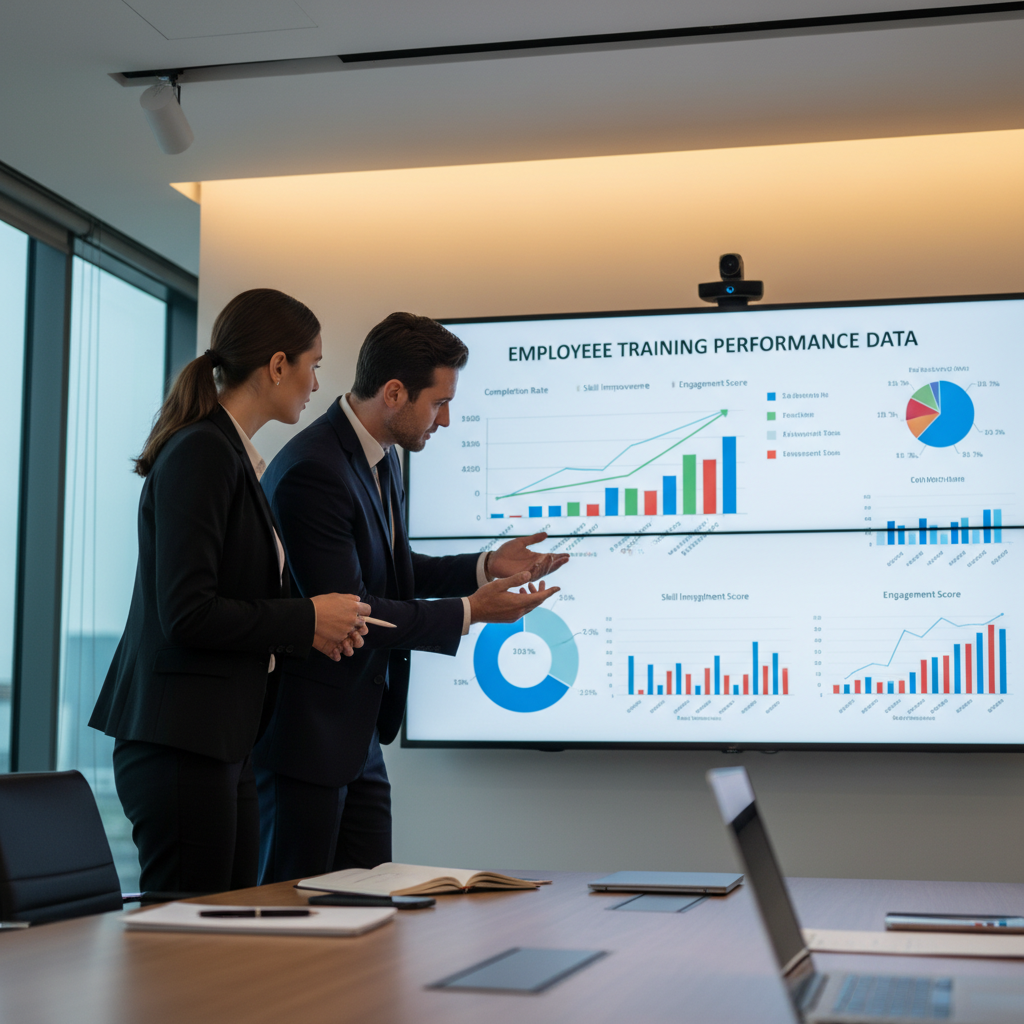
They measure application, not just completion. The shift from tracking course completions to measuring on-the-job behaviour change is the hallmark of a mature L&D function. Modern platforms make this possible by linking learning activity to performance data, giving HR and line managers visibility into whether training is actually moving the needle.
The Role of AI in Making This Work at Scale
The barrier to in-the-flow learning has always been personalisation — how do you deliver the right content to the right person at the right moment across an organisation of hundreds or thousands of people?
KnowHow removes that barrier. By connecting learning directly to performance data, KnowHow builds personalised learning paths that evolve as each employee grows. Training Goals are shaped through meaningful conversations between employees and their managers, ensuring alignment with both individual growth and organisational priorities. Insightful Analytics then give managers a real-time view of team skill development — so gaps are spotted before they become problems. And with AI-Powered Course Creation tools, L&D teams can rapidly build and deploy relevant content without the usual time and resource drain. The result is a platform that doesn’t just store learning — it actively drives it.
What This Means for Your Organisation
If your L&D strategy still revolves primarily around scheduled courses and annual compliance training, 2026 is the year to reassess. Not because those approaches have no value — they do — but because they’re increasingly insufficient on their own.
The organisations winning the talent battle right now are those that have made learning a continuous, contextual, and deeply personal experience. Their employees don’t think of training as something that happens to them. They think of it as something that helps them do their jobs better, right now.
That’s the shift. And the technology to make it happen is already here.
KnowHow is built to bring learning into the flow of work — connecting performance management, personalised learning paths, and real-time analytics in one platform.
